

Public Awareness
Statutory protection of Centrally Protected Monuments, the prohibited and regulated areas, and the law on antiquities and art treasures.
Protection of Centrally Protected Monuments
The Ancient Monuments and Archaeological Sites and Remains Act, 1958, as amended by the Ancient Monuments and Archaeological Sites and Remains (Amendment and Validation) Act, 2010, provides statutory protection to Centrally Protected Monuments and regulates activities in their vicinity.
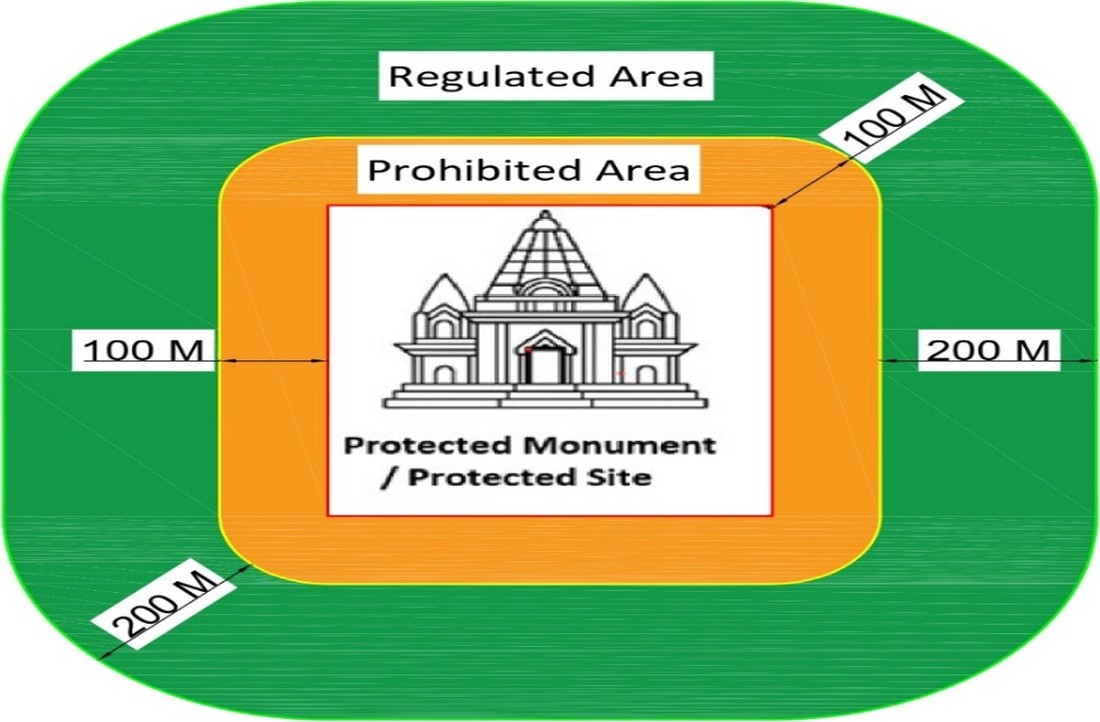
Section 20A of the Act says, “Every area, beginning at the limit of the protected area or the protected monument, as the case may be, and extending to a distance of One Hundred (100) Metres in all directions shall be the Prohibited area in respect of such protected area or protected monument”. No construction or reconstruction is ordinarily permitted within this area except as provided under the Act.
Section 20B of the Act says, “Every area, beginning at the limit of prohibited area in respect of every ancient monument and archaeological site and remains, declared as of national importance under sections 3 and 4 and extending to a distance of Two Hundred (200) Metres in all directions shall be the Regulated area in respect of every ancient monument and archaeological site and remains”. Within the regulated area, construction, reconstruction, repair, renovation or any other regulated activity requires prior permission from the Competent Authority in accordance with the applicable provisions of the Act and Rules.
Undertaking of any construction, reconstruction, repair, renovation etc. without any prior permission within the prohibited or regulated areas is liable for strict action under the relevant provisions of law.
To obtain necessary permission / NOC for construction, reconstruction, repair, renovation etc. please contact directly to the National Monument Authority through the Competent Authority & Regional Director, Eastern Region, Archaeological Survey of Indiaभारतीय पुरातत्व सर्वेक्षणভারতীয় পুরাতত্ত্ব সর্বেক্ষণ, Currency Building, 1, B.B.D. Bag, Kolkata – 700001, or submit an online application through the portal https://nmanoc.nic.in/.
Protection of Antiquities and Art Treasures
The Antiquities and Art Treasures Act, 1972 and the Antiquities and Art Treasures Rules, 1973 regulate the registration, preservation, ownership, transfer and export of antiquities and art treasures in India.
Public are requested to note that:
- Export of any antiquity or art treasure without the requisite permission of the Government of India is prohibited.
- Any antiquity discovered during excavation, construction or by accidental chance must be reported immediately to the nearest office of the
Archaeological Survey of Indiaभारतीय पुरातत्व सर्वेक्षणভারতীয় পুরাতত্ত্ব সর্বেক্ষণ, the District Administration or the Police Authorities. - Dealing in antiquities without complying with the provisions of the Act is an offence punishable under law.
- Owners of registered antiquities should ensure compliance with the prescribed procedures regarding registration and transfer of ownership.
Public Participation in Heritage Conservation
India’s Cultural Heritage is a shared national responsibility. The protection and preservation of Monuments and Antiquities require the active cooperation of Citizens, Educational Institutions, Local Communities, Visitors and Public Authorities.
Visitors are requested to:
- Respect the sanctity and historical significance of protected monuments.
- Do not deface, damage, write, paint or engrave on any monument.
- Avoid littering or causing any activity that may adversely affect the heritage fabric.
- Report any incident of vandalism, encroachment, theft of antiquities or unauthorized construction to the nearest ASI office or local authorities.
Our Commitment
The Archaeological Survey of India, Kolkata Circleभारतीय पुरातत्व सर्वेक्षण, कोलकाता मंडलভারতীয় পুরাতত্ত্ব সর্বেক্ষণ, কোলকাতা মণ্ডল, remains dedicated to the scientific conservation and sustainable management of India’s priceless cultural heritage through professional excellence, transparency, community engagement, and responsible stewardship.
“Our Heritage is Our Identity. Let us preserve it together for future generations.”